

Why Refractive Index CRMs Matter
- January 19, 2026

1 Introduction: Why Refractive Index CRMs Matter
Refractive index (RI) is a fundamental physical property used throughout analytical chemistry, metrology, quality control laboratories, and industrial process monitoring. It supports material identification, purity assessment, concentration determination (e.g., °Brix), and batch consistency.
In regulated sectors such as pharmaceuticals, food and beverage, and petrochemicals, the reliability of refractive index measurements depends directly on traceable calibration, temperature control, and uncertainty evaluation.
Refractive index certified reference materials (CRMs) provide the metrological foundation for reliable refractometry by supplying certified values with stated uncertainty and SI traceability, as established in peer-reviewed optical metrology literature [1], [4].
2. What Are Refractive Index Certified Reference Materials?
A refractive index CRM is a reference material with a certified refractive index value, assigned using validated measurement procedures and accompanied by a certificate specifying:
- Certified refractive index value
- Expanded measurement uncertainty
- Reference temperature and wavelength
- SI traceability statement
- Storage conditions and shelf life
These materials are produced by competent organizations operating under ISO 17034, ensuring homogeneity, stability, and fitness for calibration and accreditation purposes [7].
3. Role of Refractive Index CRMs in Calibration and ISO/IEC 17025 Compliance
3.1 Refractometer Calibration and Performance Verification
Abbe and digital refractometers are comparative optical instruments. Their accuracy relies on calibration using traceable refractive index standards.
RI CRMs are used to:
- Perform traceable refractometer calibration
- Conduct intermediate performance checks
- Support measurement uncertainty evaluation
Laboratory studies show that refractometers can achieve high reproducibility when calibration and temperature control are correctly implemented [2].
3.2 Accreditation and Quality Systems
Under ISO/IEC 17025, laboratories must demonstrate:
- Metrological traceability
- Appropriate reference material use
- Valid uncertainty budgets
Routine use of RI CRMs with certified values is a recognized means of meeting these requirements [6].
4. Measurement Conditions in Refractive Index Determination
Refractive index measurements are condition dependent. CRM certificates specify:
- Reference temperature
- Reference wavelength
Measurements outside these conditions without correction introduce systematic error [2], [3].
5. Importance of Temperature Control in Refractive Index Measurements
Temperature is the dominant influence quantity in refractive index measurement.
- Typical temperature coefficients: −3 × 10⁻⁴ to −5 × 10⁻⁴ RI / °C
- A deviation of 0.1 °C can exceed typical calibration uncertainty [2], [3]
5.1 Temperature in CRM Certification
Certified values are valid only at the stated temperature. Use outside certified conditions invalidates traceability if corrections are not applied [1], [5].
5.2 Temperature in Measurement Uncertainty
Temperature effects are often the largest contributors to uncertainty and must be evaluated in accordance with the GUM [5].
6. SI Traceability of Refractive Index Measurements
6.1 What Is the SI and Why It Matters
The International System of Units (SI) is the globally agreed framework that ensures measurement comparability, consistency, and reliability worldwide. It underpins scientific research, industrial production, and international trade.
Although refractive index is dimensionless, SI traceability remains essential because RI is derived from SI-traceable quantities, primarily:
- Length
- Time
- Wavelength (frequency of light)
- Temperature
SI traceability ensures that refractive index results obtained in different laboratories and countries are comparable and defensible [4], [5].
6.2 How Refractive Index Is Linked to the SI
Refractive index (n) is defined as:
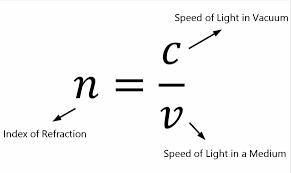
where c is the speed of light in vacuum and v is the speed of light in the medium.
Both quantities are linked to SI realizations of length and time, meaning refractive index has derived SI traceability, even though it has no unit [4].
7. Stability, Storage, and Shelf Life of RI CRMs
CRM stability studies define expiration dates and storage conditions. Improper storage is a frequent root cause of hidden bias in refractometry [3], [7].
8. Best Practices for Using Refractive Index CRMs
- Allow full thermal equilibration
- Clean prisms thoroughly
- Avoid bubbles and evaporation
- Track CRM lot numbers and expiry dates
9. Frequently Asked Questions (FAQs)
What does a refractometer measure?
A refractometer measures refractive index, which describes how light propagates through a material. Refractive index is commonly used to assess composition, purity, and concentration in liquids and transparent materials."
Why is temperature important in refractive index measurements?
Refractive index is highly temperature dependent. For many liquids, a change of 0.1 °C can cause a measurable shift in refractive index, making temperature control and equilibration essential for accurate and traceable measurements.
What is a refractive index certified reference material (CRM)?
A refractive index CRM is a reference material with a certified refractive index value, stated measurement uncertainty, and documented SI traceability. It is used for refractometer calibration, verification, and ISO/IEC 17025 compliance.
How often should a refractometer be calibrated?
In accredited laboratories, refractometers are typically calibrated in accordance with international test methods and/or laboratory quality management system, this could be a regular calibration monthly or an annual calibration, with intermediate verification checks performed based on instrument stability and usage.
What is SI traceability in refractive index measurements?
SI traceability means that refractive index values are linked through an unbroken chain of calibrations to SI units such as length, time, and temperature, ensuring global comparability and defensible measurement uncertainty.
What is the most common source of error in refractive index measurements?
The most common source of error is inadequate temperature control, followed by poor thermal equilibration, contaminated prisms, and use of expired or non-certified reference materials."
10. References (IEEE Style)
[1] J. R. Verkouteren and S. D. Leigh, Fresenius’ J. Anal. Chem., 2000. DOI: https://doi.org/10.1007/s002160000348
[2] J. Rheims et al., Meas. Sci. Technol., 1997. DOI: https://doi.org/10.1088/0957-0233/8/6/003
[3] S. A. Khodier, Optics & Laser Technology, 2002. DOI: https://doi.org/10.1016/S0030-3992(01)00110-5
[4] M. Musso et al., Meas. Sci. Technol., 2000. DOI: https://doi.org/10.1088/0957-0233/11/7/316
[5] JCGM 100:2008, Guide to the Expression of Uncertainty in Measurement.
[6] ISO/IEC 17025:2017.
[7] ISO 17034:2016.

Share on Facebook

Share on X

Share on Pinterest
Recent Posts
-
Introducing Density and Relative Density Certified Reference Materials
 May 31, 2026
 -
Introducing ARO Scientific’s Medical Grade Viscosity Standards
 April 16, 2026
 -
Extended Range of COC and PMCC CRMs
 April 10, 2026
 -
Why Refractive Index CRMs Matter
January 19, 2026
-
Refractive Index Accreditation Granted
 October 12, 2025