

Flash Point
-
- April 11, 2026
Accurate flash point determination is essential for safety, product classification and regulatory compliance across industries handling fuels, lubricants, chemicals and solvents. Reliable results depend on both validated test methods and the use of appropriate certified reference materials (CRMs) for instrument calibration and / or verification.
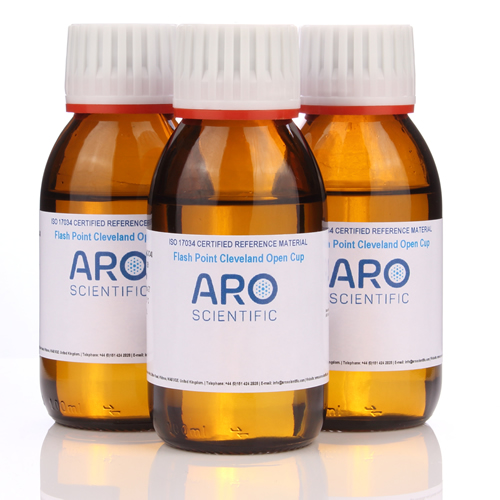
ARO Scientific has extended its range of flash point CRMs with the introduction of CRM-COC35 and CRM-PMCC35, providing additional options at temperatures for both Cleveland Open Cup (COC) and Pensky-Martens Closed Cup (PMCC) methods.
Importance of Appropriate CRM Selection
Flash point methods such as Cleveland Open Cup (ASTM D92) and Pensky-Martens Closed Cup (ASTM D93) require routine verification using certified reference materials. These materials provide traceable reference values used to confirm instrument performance.
For effective calibration and / or verification, the CRM selected should be close to the expected flash point of the test
-
- October 31, 2023
Introduction
Flash point analysis is a crucial process in various industries, including oil and gas, chemicals, and transportation. It is a method used to determine the lowest temperature at which a substance can produce enough vapour to ignite in the presence of an ignition source. Understanding flash point is essential for ensuring safety in handling and storage of flammable substances. This guide will provide you with everything you need to know about flash point analysis, including its importance, testing methods, standards, and the use of flash point certified reference materials. Whether you are a scientist, engineer, or safety professional, this guide will equip you with the knowledge and tools to effectively perform flash point analysis and mitigate potential hazards.
What is flash point analysis?
Flash point analysis is a laboratory testing process used to determine the lowest ignition temperature at which a substance can produce enough vapour to ignite in the presence of an ignition
Recent Posts
-
Introducing Density and Relative Density Certified Reference Materials
 May 31, 2026
 -
Introducing ARO Scientific’s Medical Grade Viscosity Standards
 April 16, 2026
 -
Extended Range of COC and PMCC CRMs
 April 10, 2026
 -
Why Refractive Index CRMs Matter
 January 19, 2026
 -
Refractive Index Accreditation Granted
 October 12, 2025